


Karaage Chicken makes a perfect weeknight dinner and it’s a favourite in our house. Bite-size pieces of twice-fried, golden brown chicken bursting with flavour, it’s also great as an appetiser or game day snack.
Just like these katsu prawns, despite being deep-fried, chicken karaage is very light and it isn’t greasy. It’s even quick enough to make during the week.
You’ll find loads of recipes on Sugar Salt Magic that are Asian inspired – things like these Crunchy Korean Fried Chicken Wings and Air Fryer Teriyaki Chicken Drumsticks are absolute favourites.
❤️ Why you’ll love it
- Super quick and easy – ready in 30 minutes or less.
- Loaded with flavour – from garlic, ginger and soy.
- Satisfyingly crunchy on the outside; tender and juicy inside.
- Serve it as an appetiser or main meal.
- Family friendly.
This recipe was first published here on November 2nd, 2015 and has been updated with step by step images and clearer details.

I first started making this back when we did a family “my kitchen rules” competition and has since been affectionately known as garage chicken in our house.
“Awesome recipe. Absolutely delicious. Easy to follow and quick to make. Thankyou so much!”
Kylie Lynch
Never Miss a Recipe!
Get the latest recipes straight to your inbox.
What is chicken karaage?
Pronounced ka-ra-a-geh, essentially, this is Japanese Fried Chicken. Almost as well known as teriyaki, it’s flavourful chunks of chicken thigh, marinated, then coated in potato starch then deep fried.
Karaage is a Japanese term given to the technique of deep frying small pieces of meat – it doesn’t just refer to chicken. Don’t be put off by the frying, it’s much easier than it sounds and turns out much lighter than it sounds. Karaage chicken, also known as tori karaage (translated to poultry fried) is often served alone and is a favourite at izakaya (a Japanese equivalent of a tapas bar, where they serve drinks and small food).
Katsu vs karaage: Karaage is small pieces, marinated and with a light coating of starch before being fried while katsu is a larger piece of meat, in a breadcrumb coating, then sliced after cooking. Katsu is generally served with a sweet soy-based sauce while Karaage is served with Kewpie mayo.
What is karaage chicken made of?
You’ll be amazed at the depth of flavour you can get from just the few ingredients in chicken karage.
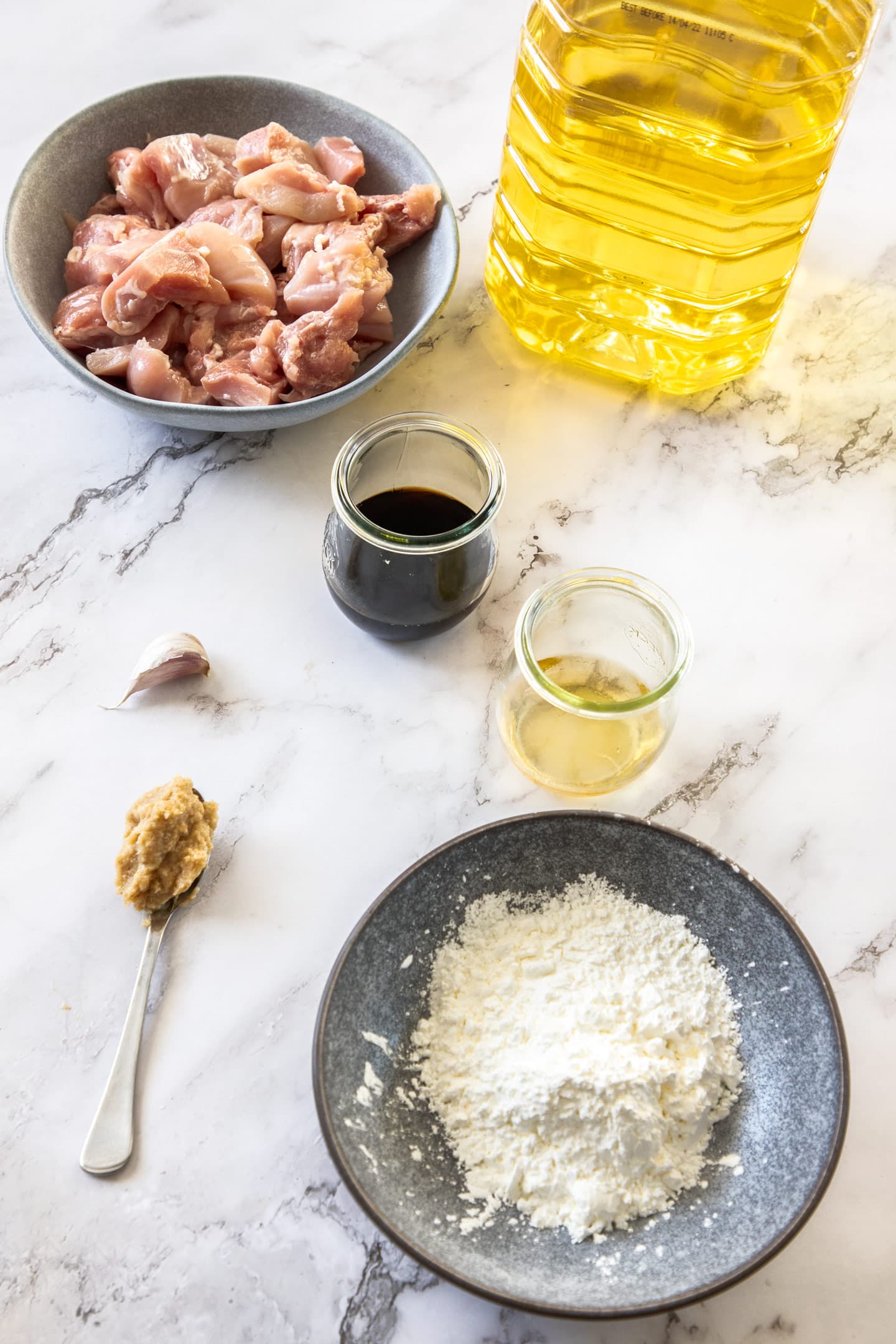
Detailed quantities and instructions in the recipe card below.
- Chicken: Use chicken thighs for best flavour.
- Soy Sauce: Japanese soy sauce (like Kikkoman brand) or even (Thai style) light soy sauce both work fine. To keep it gluten-free, use tamari in place of soy sauce.
- Mirin: This is a Japanese sweet rice wine which adds a little sweetness and acidity. It’s available in most supermarkets or you can get it from Aisan supermarkets. You could substitute with dry sherry if you absolutely need to.
- Potato starch: Traditionally made using potato starch, you can also use cornflour (US cornstarch). Potato starch is naturally gluten free but you’ll need to check the packaging of your cornflour if using that.
- Garlic and ginger: These two ingredients give this chicken so much flavour without it ever really tasting like either.
- Oil: I use vegetable oil or sunflower oil for frying. They can handle high temperatures and are perfect for deep frying too.
Serving: Serve it with some shichimi togarashi spice, a lemon wedge and kewpie mayonnaise for the perfect karage experience. Other great accompaniments are toasted sesame seeds and furikake. Pick your faves! You could also add some togarashi directly to the potato flour or a little cayenne powder to make it spicy.
The best chicken for karaage
Karaage can be made with chicken breast meat but thigh is definitely best. Breast meat will tend to be drier and doesn’t have the amount of flavour that you’ll get from thighs.
You can trim any excess fat off first if you prefer, then each thigh gets cut into 6-8 pieces, depending on their size. Also, feel free to leave the skin on if you like. I remove it only to make the dish a bit healthier (aka so I can eat more of it) but traditionally it would be fried with the skin on.
How to make karaage chicken
The trick to making a beautiful, crispy chicken karaage is the double fry and it’s that second fry that makes it super crispy (some people even triple fry it).
Detailed quantities and instructions in the recipe card below or watch me make it in the video.
1. The karaage chicken marinade
The marinade is simple and quick. Just combine the ingredients in a bowl and chill for 15-20 minutes. You can organise a salad, get the rice cooking and prep any accompaniments in that time.

2. Coat the chicken
Once your oil is ready to go, coat pieces of the marinated chicken in potato starch or cornstarch.

3. Double fry the chicken
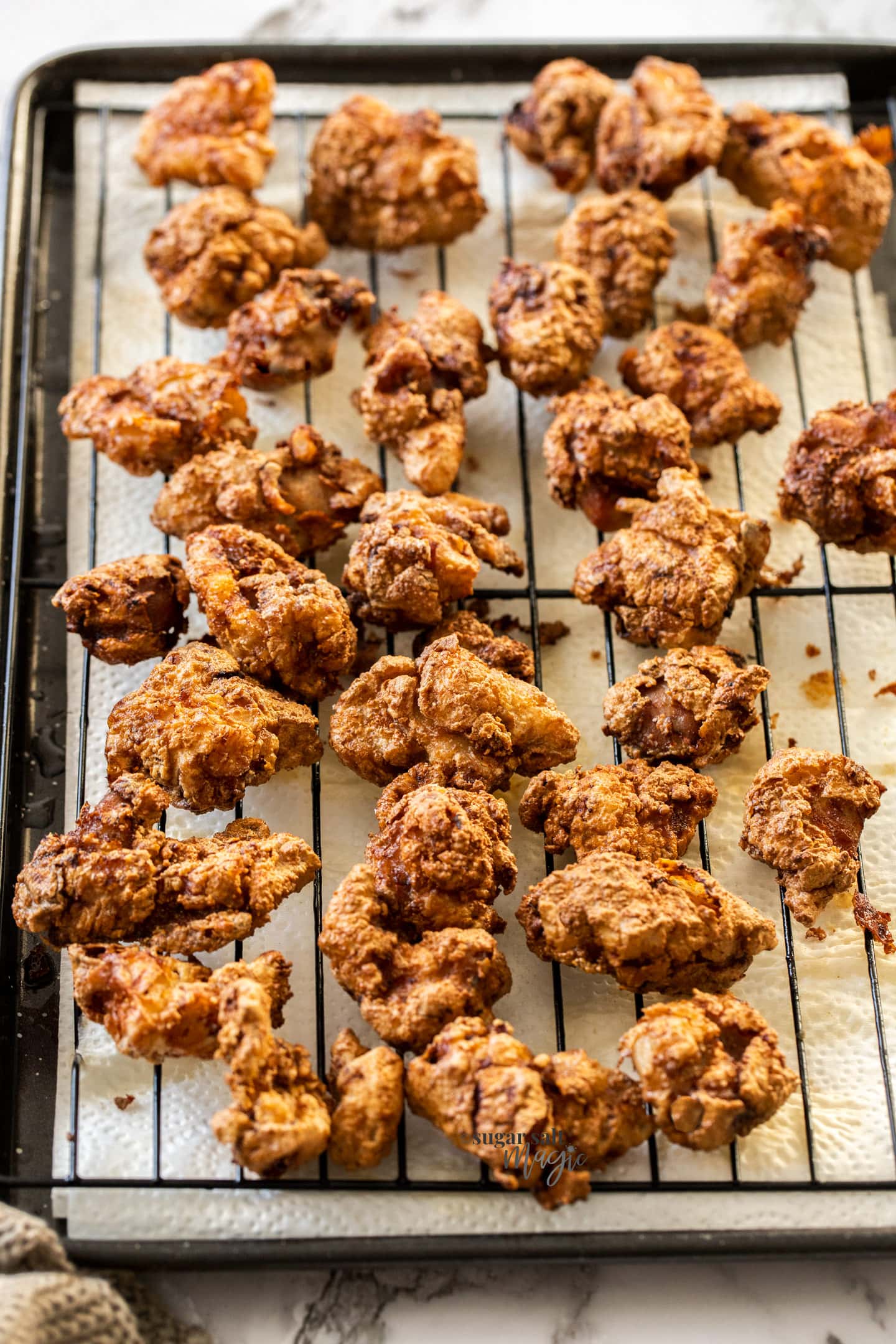
Add a few pieces of the coated chicken into the hot oil and let them cook for 90 seconds. Set the par-fried chicken pieces aside on a rack over some paper towel.
Fry in batches so you don’t overcrowd the pan and make sure to bring the oil back up to temperature (180C/350F) between each batch.

The double fry is key with karaage, so starting with the first batch again, add some chicken to the oil and fry for another minute or until it’s just cooked through.
Double frying keeps the meat juicy by mostly cooking it and sealing the coating in the first fry. The second fry gets the coating crispy. This whole process doesn’t take long at all and the chicken stays perfectly moist and juicy, while the coating gets nice and crispy.

Tips and Tricks
- Cut the chicken pieces all the same size so they cook evenly.
- You don’t want to marinate the chicken for any longer than 20 minutes. I generally stick to the 15 minute mark. That gives me just enough time to get some accompaniments ready and heat the oil.
- Get everything set up before you start frying. A baking tray lined with paper towel with a rack over the top to one side and a small bowl with potato starch or cornstarch to the other.
- Don’t coat the chicken in the starch until you’re ready to fry it or it will become a gluggy mess.
- And don’t over-coat the chicken. Just dip it enough to make sure it’s coated but you don’t need to press on heaps of starch.
Ways to serve karaage chicken
The section below goes into what to serve to accompany chicken karaage but here’s a few ideas on ways you can serve it.
- Appetiser / game day food: It’s wonderful served up as a party appetiser. All you need are some toothpicks or skewers for picking it up and a little bowl of kewpie and it’ll disappear in moment.
- Bao: Karaage is great turned into Japanese chicken bao (steamed buns).
- Burgers: Stuff this crispy Japanese chicken into buns with salad and a spicy mayo.
- Karaage don (aka karaage rice bowl): This is how I most often serve it – on top of rice with some salad to the side and a big dollop of Kewpie.
- Karaage salad: Make up a slaw using this Japanese sesame dressing and top it with crispy pieces of chicken karage.

What to serve with karaage chicken
Japanese fried chicken can be served as an appetiser or as a main meal. To serve it as a main meal, I like these accompaniments;
- Rice – perfect for making it a complete meal and the soft texture is perfect with the crispy chicken
- Sliced fresh cucumber – cool and refreshing, it’s a lovely contrast in texture but a light flavour that doesn’t mess with the full flavoured chicken. It’s also lovely dressed with this Japanese sesame sauce. Or try this Korean spicy cucumber salad.
- Pink pickled onions – I make my own but Japanese pickled vegetables or even just some pickled ginger on the side are also lovely.
- Kewpie mayonnaise – This is a Japanese mayonnaise that you can buy from most supermarkets. Don’t skip the Kewpie! It’s so so good. If you feel like a lighter, tangy sauce though, this nam jim sauce works a treat with chicken karaage.
- Tonkatsu sauce is a Japanese sweet and tangy sauce that goes nicely with karage.
- Togarashi spice – this is a Japanese peppery spice mix of things like dried chilli, pepper, poppy seeds, hemp seeds, dried citrus peel & sesame seeds. Totally optional, however, I love the little kick of spice on top.
- Roasted Miso Mushrooms: Umami filled mushroom bites are the perfect flavour and texture alongside this karaage chicken.

This has to be the quickest fried chicken to make as well. It just keeps getting better and better doesn’t it. Cut up the chicken and pour your oil into the saucepan earlier in the day and you can be serving up this flavourful chicken dish in ½ an hour.
Other recipes you’ll love
⭐⭐⭐⭐⭐
Did you try this karaage chicken recipe?
Show it some love with a rating and comment below.
Hungry for more?
- Subscribe via Email, Facebook, Pinterest and Instagram.
- Add Sugar Salt Magic as a Google Preferred Source.
Video
Ingredients
- 500 g boneless chicken thighs cut into uniform 4cm / 1 ½ inch pieces
- 1 tablespoon grated ginger (notes 1)
- 1 clove garlic crushed
- ¼ cup soy sauce
- 2 tablespoons mirin (notes)
- 1 cup potato start or cornflour (US cornstarch)
- Vegetable oil for frying
- togarashi spice, wedges of lemon and kewpie mayonnaise for serving
For best results, always weigh ingredients where a weight is provided
Equipment
- deep frying thermometer
- large heavy based saucepan
Instructions
- Mix together the ginger, garlic, soy sauce & mirin in a bowl, then add the pieces of chicken & coat thoroughly. Cover with plastic wrap and refrigerate for 10-20 minutes.
- Cover a plate or oven tray with absorbent paper towel and place a wire rack over the top. Place the cornflour in a bowl and heat the oil in a high sided saucepan to 180C / 350F.
- Remove the chicken from the fridge and one by one, take out pieces of chicken, coat in cornflour and place gently in the hot oil. – It's best to do the chicken in 4-5 batches depending on the size of your saucepan. Don't overcrowd the pot as it will cool the oil down too much and won't give you nice crispy chicken bits. – Try to keep the oil between 170-180C/340-350F for best results.
- Deep fry each batch for 1 ½ minutes, then remove and place on the wire rack. Once all batches are complete, starting with the first batch again, place the chicken back into the oil and deep fry a second time for another minute. Remove and place on the wire rack until all the chicken is done.
- Serve while still hot with Kewpie mayonnaise for dipping.
- Please take a moment to leave a comment & rating. It's appreciated and so helpful.
Notes
- Tablespoons: I use a standard Australian 20ml tablespoon (equal to 4 teaspoons). Check yours before measuring.
- A deep frying thermometer is very handy to keep an eye on the oil temperature. They are relatively cheap and useful in candy making as well.
- I most often serve this as a main meal with steamed rice, cucumber, pink pickled onions and a sprinkling of togarashi.
- Potato starch is traditional but cornflour (AUS) / cornstarch (US) works well too.
- Nutrition details are approximate only – scroll below the recipe to find the full nutritional information.
SPECIALTY INGREDIENTS
- Mirin is a Japanese sweet rice cooking wine. Great to have on hand as it will last for a long time and is used in many Japanese dishes including sushi rice and Japanese pickled vegetables
- Togarashi spice is a Japanese peppery spice mix of things like dried chilli, pepper, poppy seeds, hemp seeds, dried citrus peel and sesame seeds. It is optional in this dish but does add a nice spicy kick
- Kewpie mayonnaise is a Japanese mayonnaise that you can buy from most supermarkets and grocery stores. Don’t skip the Kewpie in this dish.
FAQs
Karaage chicken is incredibly crispy due to the twice-frying technique.
Soggy fried chicken can be caused by the oil not being hot enough and not cooking for long enough.
Karaage flour, traditionally, is simply potato starch. Nothing more. I often use corn starch which works just as well and easier to get for me.
Use a neutral flavoured vegetable oil for frying. It has a high smoke point meaning it can withstand high cooking temperatures without burning.
This post may contain affiliate links that earn me a small commission for my referral, at no extra cost to you. Thank you for supporting Sugar Salt Magic.


12 Comments on “Karaage Chicken (Japanese Fried Chicken)”
I’m making this recipe to put into sushi rolls, is there anything I should avoid in chilling them? Also will they be ok to cook the night before then chill and eat the next night?
Thanks
Hello Elizabeth. Just keep in mind, the further ahead they’re made, the softer the crust will become. When you chill them, don’t cover them until they’re totally cold or it will create condensation that’ll make the outside soggy. I’d love to hear how your sushi turns out 🙂
Love the simplicity of this recipe. Made these to go into steamed baus with crunchy Asian slaw, chilli and Sriracha.
Absolutely a hit for entertaining. Great for Aussie summer. Thanks for the recipe.
Sound delicious in bao. Yum. Thanks so much for dropping back to review 🙂
Awesome recipe. Absolutely delicious. Easy to follow and quick to make. Thankyou so much!
So happy you love it, Kylie. Definitely a favourite in our house.
I just found this recipe an hour ago and instantly made it for tonight’s dinner (as I have all ingredients needed)
I coated the chicken with potato starch, and followed the frying process as suggested above.
Before serving, I sprinkled the karaage chicken with Toragashi spice (plus toasted white sesame seeds) on top, and served it with steamed rice, steamed broccoli, sliced fresh cucumber, Kewpie mayonnaise (mixed with chilli flakes and a splash of lemon juice) for dipping, and garnished with shredded carrots + cabbage. And it turned out very delicious and fulfilling, even my son ate them like crazy👍🏻🤩
Thanks a lot for your wonderful recipe, dear Marie 🤗.
Will definitely make it again 🙂
Excellent. I’m so so happy you love it Nath.
Tried this recipe a few months back and my whole family love it (trust me they are fussy eaters) i serve it with sushi rice on bottom and kewpie mayo & teriyaki sauce drizzled on top.
Thanks so much Jeannine. I’m so happy your family loves it. It’s definitely one of our favourites.
I made this dish for my husband and two young kiddies one arvo after work, quick to prepare and cook, it was delish! Kids loved the crispy chicken, served it just as the recipe suggests, delicious, this one will be made again!
Thanks Lisa. Glad you all loved it 🙂