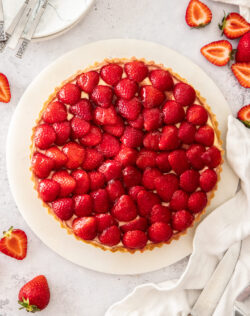
Easy strawberry custard tart has a buttery shortcrust base, melt in the mouth pastry cream and fresh strawberries. It’s a summer showstopper.
Ingredients
TART SHELL (SHORTCRUST PASTRY)
- 225 g plain flour (all purpose flour) (8oz)
- 50 g white granulated sugar (¼ cup / ~1 ¾ oz)
- 100 g unsalted butter cold and cubed (7 tablespoons / 3 ½)
- 1 large egg cold
- 1 ½ tablespoons water cold (6 tsp, notes 1)
FOR THE FILLING
- 3 ¼ cups milk (810ml / 1 ¾ pints)
- 57 g butter (¼ cup / ½ stick / 2oz)
- 3 teaspoons vanilla extract (or vanilla bean paste)
- 100 g granulated white sugar (½ cup / 3 ½oz)
- ½ cup cornflour (US cornstarch) (65g / ~2 ⅓oz)
- 2 large eggs
- 3 egg yolks, from large eggs
FOR THE TOPPING
- 4 cups small strawberries (500g / ~1lb)
- 2 tablespoons strawberry jam
For best results, always weigh ingredients where a weight is provided
Equipment
- stand mixer Or see post for using a food processor
- 9 inch fluted tart pan
- Rolling Pin
- pie weights or rice
- heavy based saucepan
Instructions
- FOR THE TART SHELL:In the bowl of a food processor, add the flour, sugar, cubed butter and a pinch of salt. Process on low until the pieces of butter are about pea-sized. See notes 3 to make without a food processor.
- Add the egg and process until it looks a bit like breadcrumbs.
- With the food processor running on low, drizzle in the water until it starts forming clumps.
- Turn the pastry out onto a clean work surface and gently pull it together. Knead it only enough to make it mostly smooth.
- Now, on a lightly floured work surface, dust the top of the pastry with flour too and gently roll it out, turning it often, to about 4-5mm thick or about 11 inches in diameter.
- Place the rolling pin in the middle of the dough and fold one side of the pastry over the top. Lift the rolling pin so the pastry is hanging over it, and lightly dust off any excess flour from underneath. Carefully lay it into a 9 inch round tart pan with removeable base.
- Press the dough down in to the corners all the way round, then press it into the scalloped sides. Leave the overhang standing upright and place the tart pan into the fridge to chill for a minimum of 2 hours or overnight. If your freezer has space you can place it in there.
- BAKE THE TART SHELL:Preheat the oven to 180C (160C fan) / 350F.
- Use a fork to prick the pastry base all over. Use a small sharp knife to trim off the excess pastry.
- Line the tart shell with a sheet of baking paper and fill with pie weights or rice. Fill it quite full and making sure it’s pressed up tight against the edges.
- Bake for 20 minutes. You can proceed with making the filling while it bakes.
- After 20 minutes. Carefully remove the baking paper and rice (or weights) and bake a further 15 minutes or until golden then set the tart shell aside.
- FOR THE CUSTARD FILLING:Pour the milk into a heavy based saucepan, and add the butter, sugar and vanilla, then heat over medium heat until steaming, stirring regularly.
- While the milk mixture is heating, whisk together the cornflour, eggs and egg yolks until combined.
- Once the milk mixture is steaming, drizzle it slowly into the eggs while whisking constantly. Don’t pour it too quickly or the heat will scramble the eggs.
- Return the entire mix to the saucepan. Heat over low-medium heat, stirring with a balloon whisk constantly, until it gets very thick. This will happen quite suddenly after about 5 minutes, so it’s important to keep stirring so you don't get lumpy custard. Let it come to a bubble and then cook, stirring constantly for another 30-60 seconds. It should be so thick at this point that it doesn't settle back into itself.
- Remove from the heat and allow to cool for a couple of minutes before pouring into your tart shell. Level out the top with an offset spatula or knife.Depending on the depth of your tart shell, you may have more custard than you need to fill it. You can put any excess into ramekins and have them as a treat.
- Cover tightly with plastic wrap pressed to the surface and place in the fridge and chill for 3 hours to set. Top with strawberries on the day of serving.
- FOR THE TOPPING:Wash the strawberries and dry well. Hull them. Keep one whole, then cut the rest in half. Set aside.
- Warm the strawberry jam in the microwave for 10-15 seconds.
- Place the whole strawberry in the centre of the custard. Arrange the halved strawberries around it in a spiral.
- Brush with the jam and chill for at least another ½ hour.
- Please take a moment to leave a comment & rating. It's appreciated and so helpful.
Notes
- All ovens vary – always test for doneness 3-5 minutes before the recipe suggests
- For best results, you should always weigh ingredients like flour and sugar. Kitchen scales are relatively cheap but if you can’t weigh the ingredients, use the spoon and level method (don’t scoop).
- If you don’t have a food processor, grate cold butter into the bowl with the flour and sugar and cut the butter in using a knife, your fingertips or a pastry blender.
- You can flavour your dough with a little vanilla extract or lemon zest too.
- If your dough is too crumbly, and you’ve correctly weighed the flour, sugar and butter, it could be due to the size of your egg. The dough should be soft and pliable so If you need to bring it together a little more, just add a touch of cold water.
Love this recipe?Add Sugar Salt Magic as a preferred Google source.
Nutrition information is approximate only and derived from an online calculator. The brands you use and any changes you make may cause variations.
